
Banshee: The Terrifying Messenger of Death in Irish Mythology

The Banshee      

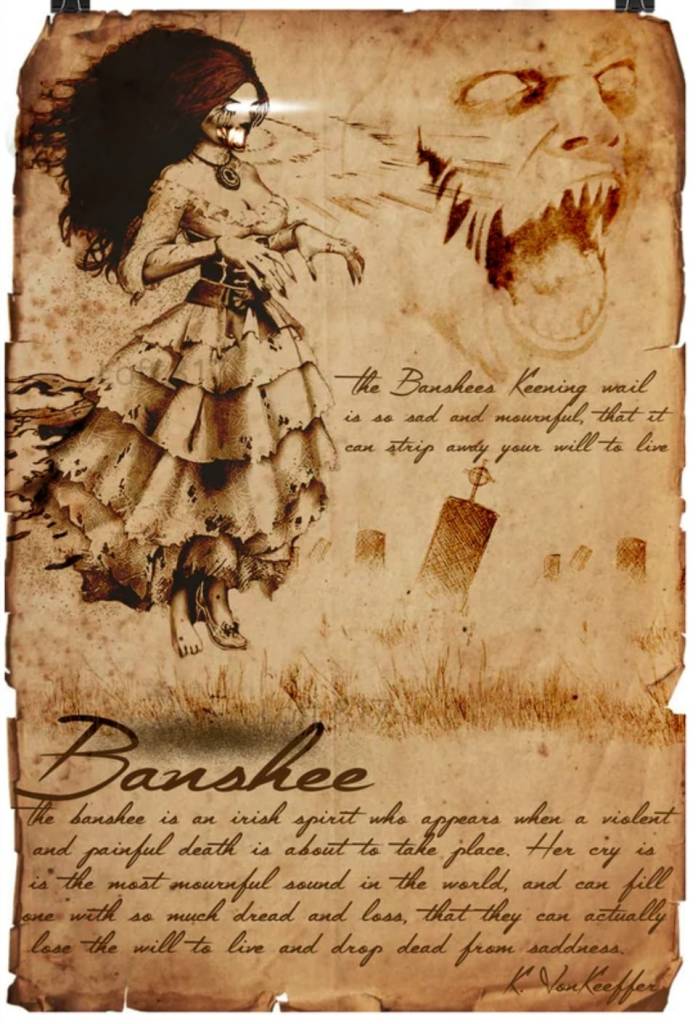
The Banshee or “bean síor “bean sidhe”in Irish Mythology, is a female spirit-like creature that is usually seen as a death omen or a messenger from the underworld. The term banshee translates from Old Irish (ben síde) as ‘Woman of the fairy mound” or “fairy woman.”

According to legend, the wail of the banshee is a warning that someone is about to die. In Scottish Gaelic mythology, she’s known as the bean sìth or bean nighe and is reported to be washing the bloodstained clothes or armor of those marked for death. She is also referred to as the “Washer Woman.” Sightings have been for centuries and are also known in both Welsh and Norse folklore, with some reports coming from the United States.

  The scream of a banshee is known as the “caoine” which translates as the “keening.” Originally, it was a mark of death in one of the five major Irish families: the O’Grady’s, the O’Neills, the O’Briens, the O’Connors, or the Kavanaughs. With the blending of families through the centuries, it is now believed that most Irish families have their own banshee attached to them. As families left Ireland and emigrated around the world, it is believed that banshees followed those families, as well.

Descriptions vary from a woman with long red hair and deathly pale skin to an old hag with stringy grey hair, rotten teeth, and fiery red eyes. She was often depicted as having a comb in her hair and this detail led to the Irish belief that finding a comb on the ground is bad luck. It is also believed that she can change her form at will, resembling either or both versions.

The Bean nighe is supposedly the ghost of a woman who died during childbirth, but this version is found more in Scotland. She is described as wearing the clothes of the person about to die, while the “Washer Woman” is seen as dressed like a normal woman but is stooped over and cleaning bloody rags in a body of water.

It is believed that if a Banshee discovers that a human is watching her, she will vanish in a cloud of mist, and it sounds like the flapping of bird wings. Many believe that the banshee doesn’t actually cause death, but merely warns of it.

Sightings go back centuries, and the lore is often contradictory, but the banshee is a terrifying creature that deserves a great deal of respect. Whether you choose to believe it or not, there is simply too much lore on this subject to dismiss it outright. You do so at your own risk. After all, every legend and myth have its roots in something that really happened.

Just because you don’t believe in the fae folk, doesn’t mean they aren’t out there. Some are good and actively help people, but others are dark and dangerous. None should be taken lightly.

The Headless Horseman: Folklore and Legends From Around the World

While most of us immediately think of “The Legend of Sleepy Hollow” by Washington Irving, the lore on creatures like this dates back centuries.

The Headless Horseman

While most of us immediately think of “The Legend of Sleepy Hollow” by Washington Irving, the lore on creatures like this dates back centuries.

In Irish folklore, it’s called the “dullahan” or “dulachán”, which means dark man. It usually is depicted riding a horse and carrying its head beneath its arm. It is believed to be a dark fairy or fae. Some versions say it is the spirit of the Celtic God Crom Dubh who wields a whip made from a human spine. When the rider stops can calls out a name and that person dies instantly.

A similar figure is called the “gan ceann” (meaning without a head) and it is the headless driver of a black carriage called “the cóiste bodhar” which means death coach or silent coach. This version is found in Britain and the United States as well. In Scotland, it is seen on the Royal Mile of Edinburgh where it collects the souls of the dead.

In Welsh folklore, there are stories of headless horsemen and woeman. The “Fenyw heb an pen” (the headless woman) who rides “Ceffyl heb un pen” or horse without a head. Bryn Hall in Llanymawddwy is said to have been haunted by a headless horseman and only stoppy when one of the servants there discovered it was trying to give them a message and it led to the discovery of a body buried on the grounds. The body was allegedly the illegitimate child of Lord Bryn.

In German folklore, mostly in Rhineland, the headless horseman kills its victims by touching them. They were believed to be revenants that were cursed to walk the earth until they atoned for their sins. Sometimes they would do good deeds for strangers but would not shake their hands, instead they would grab a tree branch that would whither and die. Another version is “Der Kopfloser Reiter” (the headless horsemen) who warns the living of danger and would chase down the wicked to punish them.

In England, there is said to be a headless rider that haunts the area around Dartmoor. In Arthurian legends, the Green Knight was beheaded by Sir Gawain, but did not die. He retrieved his head and left after reminding Gawain to meet him at the Green Chapel in a year to complete the challenge.

In American folklore, there is a figure in southern Texas called “El Muerto.” Stories of El Muerto have been circulated since the mid 1800s. Allegedly, he carries his head dangling from his saddle and his horse produces lighting from its hooves as they strike the ground. This is believed to be based on another legend where a horse thief was captured and beheaded. His corpse was tied to a wild horse and sent running.

Varies books, movies and television shows have used the headless horseman theme as well, including an episode of “Kolchak: the Nightstalker” called Chopper where a headless motorcycle rider sought revenge for his killing.